Most goals fail before they even start. Not because of a lack of ambition, but because the goal was never clear enough to act on.
“Improve team performance.” “Grow revenue.” “Get more organized.” These sound like goals. They feel like goals. But they are wishes, not plans.
| SMART goals are goals designed to be Specific, Measurable, Achievable, Relevant, and Time-bound, so they are easier to plan, track, and complete. |
The SMART framework exists to close the gap between intention and execution. Whether you are a manager setting quarterly targets, a team lead aligning your squad around shared outcomes, or an individual trying to move a project forward, SMART goals turn ambiguity into action.
What Are SMART Goals?
SMART is an acronym. Each letter defines a quality that a well-written goal should have. Together, the five criteria turn a vague direction into something concrete you can assign, schedule, and track.
| S | Specific | What exactly needs to happen? Name it clearly. |
| M | Measurable | How will you know you’ve hit it? Attach a number. |
| A | Achievable | Is this realistic given your current capacity and constraints? |
| R | Relevant | Does this goal connect to what actually matters right now? |
| T | Time-bound | When does it need to be done? Open-ended goals rarely get done. |
Why SMART Goals Work
In practice, clear goals tend to outperform vague ones because people know what they are trying to achieve and exactly how progress will be measured. There is less room for misinterpretation, less wasted effort on the wrong things, and fewer conversations that end with everyone nodding but no one knowing what happens next.
For teams specifically, this matters more. When goals are clear, ownership is easier to assign. When ownership is clear, accountability follows naturally. And when everyone can see the same target, alignment stops being a management problem and starts being a natural byproduct of the work.
How to Write SMART Goals: Letter by Letter
Here is how to apply each criterion in practice, including what a weak goal looks like and what a sharper version looks like instead.
S: Make it Specific
Specific means naming what will change, who is involved, and what action produces the result. If the goal could apply to ten different projects, it is not specific enough.
| Before Improve customer support. |
| After Reduce average support ticket response time from 24 hours to 6 hours by end of Q2. |
M: Make it Measurable
A measurable goal has a number attached. A percentage, a revenue figure, a count, a score. Without a metric, you cannot track progress or confirm completion.
| Before Get more leads. |
| After Increase qualified inbound leads by 25% in Q3, tracked through the CRM. |
A: Make it Achievable
Achievable does not mean easy. It means grounded. A goal that is wildly disconnected from your team’s current capacity does not motivate action. It creates paralysis. Use your recent baseline as your anchor point.
| Before Triple revenue this quarter. |
| After Grow monthly recurring revenue by 15% this quarter through three targeted upsell campaigns to existing accounts. |
R: Make it Relevant
Relevant goals serve a real priority. Before writing the goal, ask: why does this matter right now? If the answer is vague, the goal probably is too.
| Before Build a new internal dashboard. |
| After Build a pipeline visibility dashboard for the sales team, reducing time spent on manual weekly reporting by 3 hours per person. |
T: Make it Time-bound
Deadlines are not stressors. They are commitment devices. Without a timeframe, goals exist in a state of permanent deferral.
| Before Launch the new onboarding flow. |
| After Launch the redesigned onboarding flow by March 31, targeting a 65% activation rate within the first 7 days. |
SMART Goals Examples Across Common Work Scenarios
Here is how the framework looks across different teams and functions. Each example shows a vague starting point and a SMART version that is actually usable.
Employee Performance
Vague: Get better at presenting to stakeholders.
| SMART Deliver three internal presentations by June 30, with peer feedback scores averaging 4/5 or above, after completing a business communication workshop in May. |
Marketing
Vague: Grow blog traffic.
| SMART Increase organic blog traffic by 25% in Q2 by publishing four high-intent articles and updating older posts already ranking on page two. |
Sales
Vague: Close more deals.
| SMART Increase win rate from 22% to 27% by end of Q3 by enforcing same-day lead follow-up and reviewing stalled deals every Friday. |
Project Management
Vague: Deliver the product update on time.
| SMART Ship version 2.4 by April 15, covering the three features in the current sprint, with fewer than 5 post-launch critical bugs in the first two weeks. |
HR and Recruitment
Vague: Reduce time to hire.
| SMART Cut average time-to-hire for engineering roles from 42 days to 28 days by Q4 by reducing internal approval stages from five to three. |
Personal Development
Vague: Get better at data analysis.
| SMART Complete a SQL fundamentals course and produce two internal reports using live data by end of July, signed off by the analytics lead. |
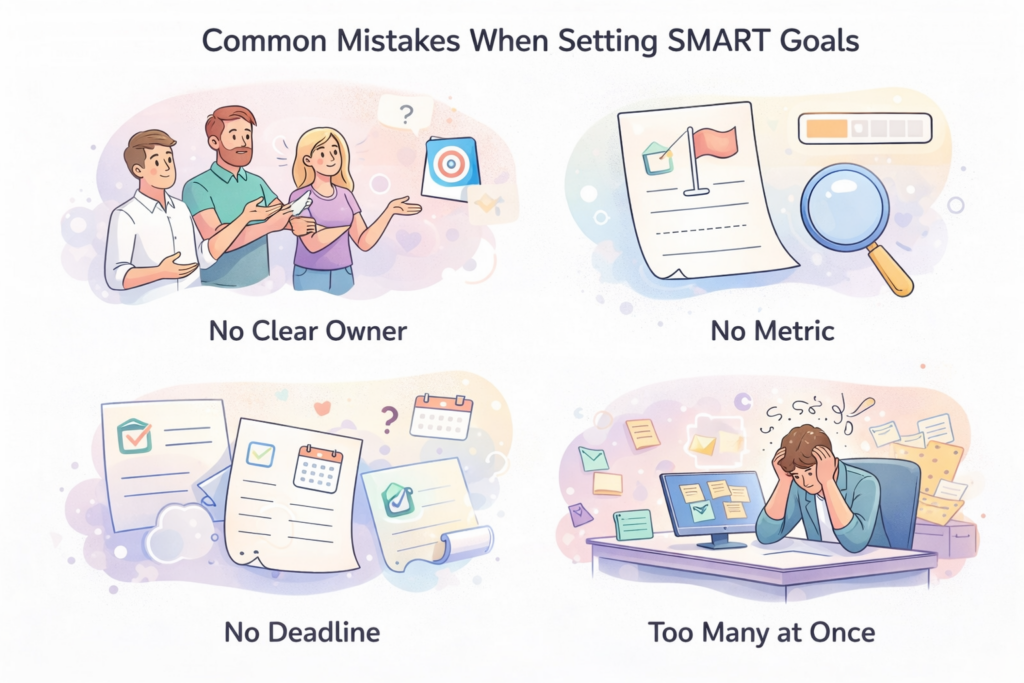
Common Mistakes When Setting SMART Goals
The framework helps, but it does not automatically prevent bad goal writing. Here are the patterns that undermine otherwise well-intentioned work.
- Goals that are too broad to act on. If the goal could apply to ten different projects, it is not a goal yet. Pick one specific dimension and define it clearly.
- No metric attached. A direction is not a target. If you cannot measure it, you cannot track it.
- Stretch numbers with no baseline. Ambitious targets need an anchor. Without knowing where you currently stand, planning is guesswork.
- Goals disconnected from current priorities. A well-written goal that serves no real team or business need is still a distraction.
- No deadline. Open-ended goals drift indefinitely. Set a date, even if it gets adjusted later.
- Written once, never reviewed. A goal without a tracking process is just a document. If no one is checking in on it, it will not get done.
Why SMART Goals Still Fail Even When Written Well
Here is the part most goal-setting articles skip over. Writing a well-formed SMART goal is not enough. A goal can pass every letter of the framework and still go nowhere.
The most common reasons are operational, not structural.
- No named owner. When a goal belongs to the team without a specific lead attached, accountability evaporates. Someone needs to be responsible for it.
- No review rhythm. A 90-day goal checked on day 89 is not being tracked. Build in a 30 and 60-day check-in before the deadline arrives.
- Not connected to tasks. Goals that live in a separate doc from the actual work get forgotten. The goal needs to exist inside the workflow, not parallel to it.
- Too many goals at once. When everything is a priority, nothing is. Three focused goals will move faster than ten scattered ones.
- No shared visibility. When goals are siloed, alignment breaks down. People optimize for their own piece without seeing how it connects to the whole.
Writing the goal is step one. Building the system around it is what determines whether it actually gets done.
SMART Goal Template
Use this as a starting point. Adjust the language to match your team’s voice, but make sure all five criteria are present.
| “[Who] will [specific action or outcome] by [deadline], measured by [metric], because it supports [team or business objective].” |
Example: The content team will publish 8 SEO-focused articles by March 31, measured by monthly organic sessions, in order to reduce paid acquisition costs and grow top-of-funnel reach.
For performance reviews and individual goals, the same structure works: “I will [action] by [date], tracked by [metric], in support of [team priority].”
Vague Goals vs. SMART Goals
Here is the difference in plain terms. The vague version tells you what you care about. The SMART version tells you what you will do, when, and how you will know it worked.
| Vague Get more customers | SMART Acquire 40 new paying customers in Q2 through outbound and referral campaigns, tracked weekly in the CRM. |
| Vague Improve the website | SMART Increase homepage conversion rate from 1.8% to 2.4% by May 31 by redesigning the hero section and adding two customer case studies. |
| Vague Make the team more efficient | SMART Reduce time spent in recurring meetings by 20% by April 15 by auditing current meetings and cutting or shortening those with no defined output. |
| Vague Onboard new hires better | SMART Reach a 30-day onboarding satisfaction score of 4.5/5 in Q3 by redesigning the onboarding checklist and pairing each new hire with a buddy for their first month. |
Keeping SMART Goals Alive in Real Work
Once the goal is written, the operational side begins. This is where most goals either stick or quietly disappear.
Goals work when they are embedded in the workflow, not stored separately from it. That means:
- Break the goal into tasks with owners and due dates.
- Set a mid-point review. Do not wait until the deadline to find out you are off track.
- Document updates as the work happens. Context shared in real time is far more useful than a retrospective summary.
- Keep goals visible across the team. When everyone can see what others are working toward, coordination improves and dependencies surface earlier.
The goals that get completed are almost always the ones tied directly to the work, not the ones sitting in a separate planning doc. If goal-setting and task management live in different places, that gap is where follow-through breaks.
| Close the gap between goal and execution When goals live in one doc, updates live in Slack, and tasks live somewhere else entirely, follow-through breaks down. Skarya.ai keeps goals, tasks, owners, and progress in one visible workflow, so nothing gets lost between planning and delivery. |
Frequently Asked Questions
What are SMART goals?
SMART goals are goals that are Specific, Measurable, Achievable, Relevant, and Time-bound. The framework turns broad intentions into trackable work with a clear metric, owner, and deadline.
What is an example of a SMART goal?
“Increase win rate from 22% to 27% by end of Q3 by enforcing same-day lead follow-up and reviewing stalled deals every Friday.” It names the metric, the method, and the deadline.
Why do SMART goals work better than regular goals?
They remove ambiguity. When a goal is specific and measurable, everyone knows what success looks like. When it is time-bound, there is a date to plan backward from. Vague goals invite different interpretations, which is where misalignment starts.
How do teams use SMART goals?
Teams write goals at the team level, break them into tasks with individual owners, and review progress at set intervals rather than waiting for the deadline. It gives managers and employees a shared, unambiguous definition of success.
What is the SMART goal template?
[Who] will [specific action] by [deadline], measured by [metric], because it supports [objective]. All five criteria should be present.
Can SMART goals be used for performance reviews?
Yes. They work well in performance management because both manager and employee agree upfront on the criteria. When the review arrives, there is no debate about whether the goal was met.
The Takeaway
Vague goals are not a motivation problem. They are a design problem.
The SMART framework gives you a repeatable structure for writing goals that can be planned, owned, and finished. Use it for performance reviews, team objectives, project milestones, or anything you want to actually get done.
Write the goal. Name an owner. Break it into tasks. Check in before the deadline.
Most goals fail because no one built a system around them. Now you have one.